
Psychology/Downloads/PMA Emotional Awareness & Regulation Workbook
Language:EnglishEspañolPortuguês (BR)
Downloads · Professional resource
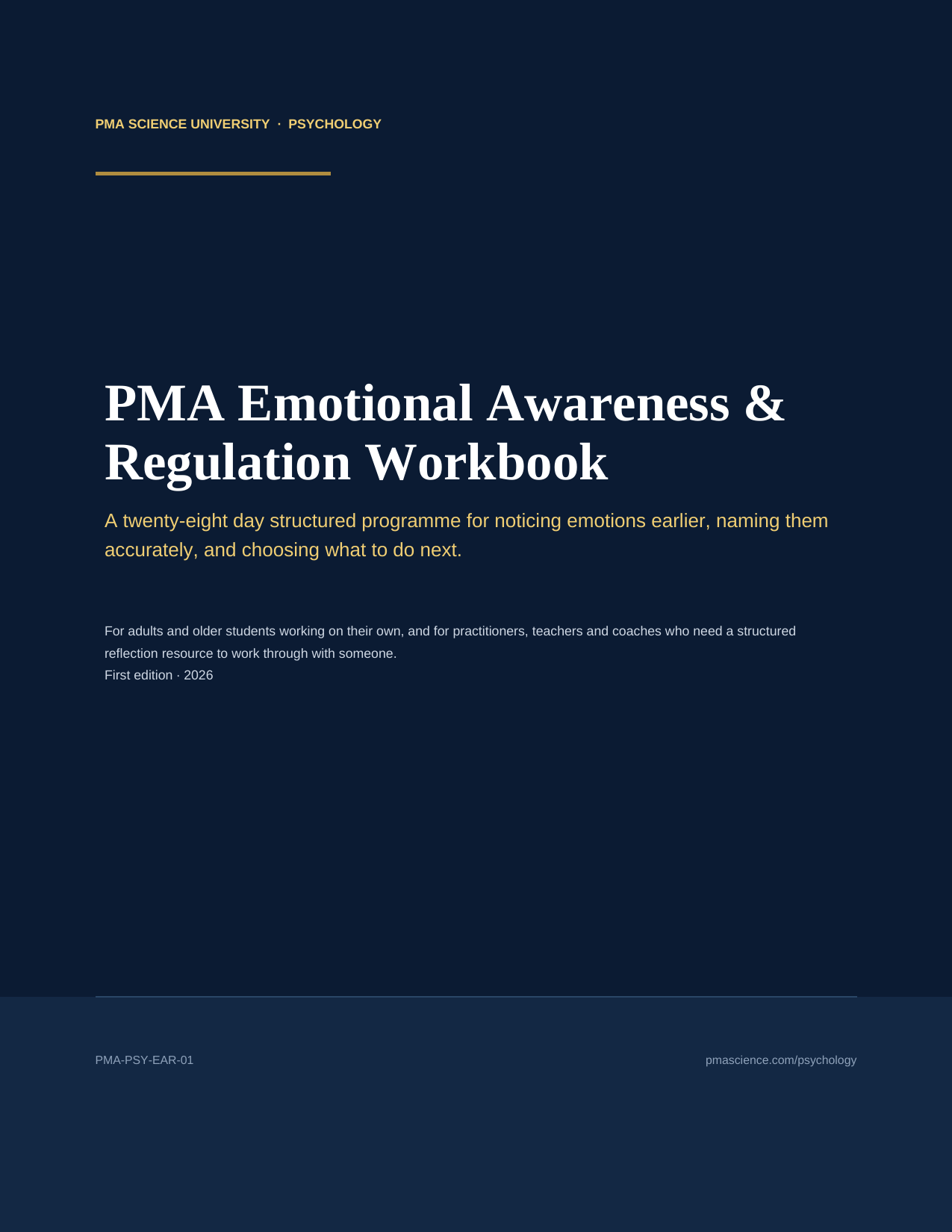
PMA Emotional Awareness & Regulation Workbook
A twenty-eight day structured programme for noticing emotions earlier, naming them accurately, and choosing what to do next.
- Format1 PDF, 19 pages, print-ready at US Letter
- DeliveryInstant download after purchase
- LicenceSingle-user — print and use for your own practice, study, classroom, household or caseload
- PublisherPMA Science University · Psychology
- ReferencePMA-PSY-EAR-01
$15.00USD · one-off · instant download
- Payment and delivery are handled by the PMA Science University store.
- Your download is available immediately after payment, and remains in your account.
Why this exists
Most people do not have an emotion problem. They have a timing problem: by the moment an emotion is obvious enough to name, it is already running the decision. This workbook moves the point of noticing earlier along the curve — and matches strategies to the point where they actually work.
What is inside
Part One · How emotional awareness actually works
- The four channels — body, attention, thought and impulse — and the order in which they arrive.
- Six container words unpacked into precise names, with why each precision changes the action.
- The five-point intensity curve, with what helps and what is useless at each point.
- Why regulation is not calm, and why aiming at calm increases the emotion.
Part Two · The daily practice
- The NAME sequence — Notice, Accept, Mark, Elect — four minutes, twice a day.
- A body map to complete in week one and again in week four.
- An early-signal inventory, including what other people notice before you do.
- A two-entry daily log with conditions, and an episode debrief for anything above 7/10.
Part Three · The strategy library
- Thirty-two strategies sorted by point on the curve, not by category.
- Eight for conditions, eight for the early rise, eight for the steep rise, five for the peak, seven for the descent.
- A one-card regulation plan — two strategies per point — you can carry.
Part Four · Weekly reviews and the twenty-eight day arc
- Four structured reviews: noticing, naming, choosing, consolidating.
- A progress record tracking entries, distinct names used, mean intensity and earliest point noticed.
- A clear statement of the point at which self-reflection stops and professional help begins.
Who it is for
Adults and older students working on their own, and practitioners, teachers and coaches who want a structured reflection resource to work through with someone.
Scope and limits
This is an educational and professional documentation resource. It is not a diagnostic instrument, a psychometric test, or a substitute for assessment, treatment, supervision or emergency care by a qualified professional.
It applies no score, threshold or classification to any person, and it reproduces no third-party questionnaire, coding manual, certification syllabus or clinical instrument. All content is original PMA Science material.
Related reading on this platform
Educational scope. Everything published on PMA Science Psychology is provided for education, study and professional documentation. Nothing here is a diagnostic instrument, a psychometric test, or a substitute for assessment, treatment, supervision or emergency care by a qualified professional.
If you are at risk right now, contact your local emergency number or a crisis line immediately. Read our boundaries and safety statement.