

Rising Above: Puberty and Mental Health in Adolescents
Rising Above: Puberty and Mental Health in Adolescents
PMA Science University · Educational · Motivational · Evidence-Based

Dawn after a storm—a small boat steering toward light. Alt text: “Teen steering into calm water after rough waves.”
“Adolescence isn’t a glitch—it’s a forge.” Puberty is the heat; mental health is the metal being shaped. When we understand both, we stop fearing the fire and start mastering it. This blog-guide blends brain science, Stoicism, and Positive Mental Attitude (PMA) so families and schools can turn chaos into choreography—and teens can steer, not just drift.
Understanding the dynamics of adolescence is crucial for mental well-being. In this context, ‘Rising Above: Puberty and Mental Health in Adolescents’ serves as a guiding principle for parents and educators alike.
Note: The book is now available on Amazon, Kobo Books, Apple Books, and Google Play. Audio versions will soon be available on Evarand and other platforms.
“Maps matter—especially in storms.” The ideas below are expanded in the book Rising Above: Puberty and Mental Health in Adolescents by Jay Pacheco. If this article is a shoreline, the book is the sea chart you’ll want on your desk: stories, diagrams, and classroom-ready practices you can use the same day. Buy link eBook: https://a.co/d/3QNvJem and paperback: https://a.co/d/faDIouC
The Crucible: What Puberty Really Is
“Puberty is the engine; adolescence is the journey.” A tiny conductor in the brain (the hypothalamus) cues the pituitary; hormones surge; bodies lengthen; sleep rhythms shift; motivation and attention retune. None of this is random. It is a biological symphony designed to prepare a young person to join and serve their community.
“An accelerator with developing brakes.” The limbic system (emotion/reward) upgrades before the prefrontal cortex (planning/impulse control). Translation: big feelings and novelty-seeking are normal while the “brakes” are still wiring up. Guidance at this stage isn’t micromanagement—it’s installing guardrails on a mountain road.
“Invisible tides move the shoreline.” Puberty pushes melatonin later, so many teens aren’t sleepy until ~11 p.m. Early bells then rip them from deep sleep. The result can look like “attitude,” but it’s often sleep debt. Protect sleep like oxygen: consistent bed/wake times, darker rooms, morning light, and predictable routines.
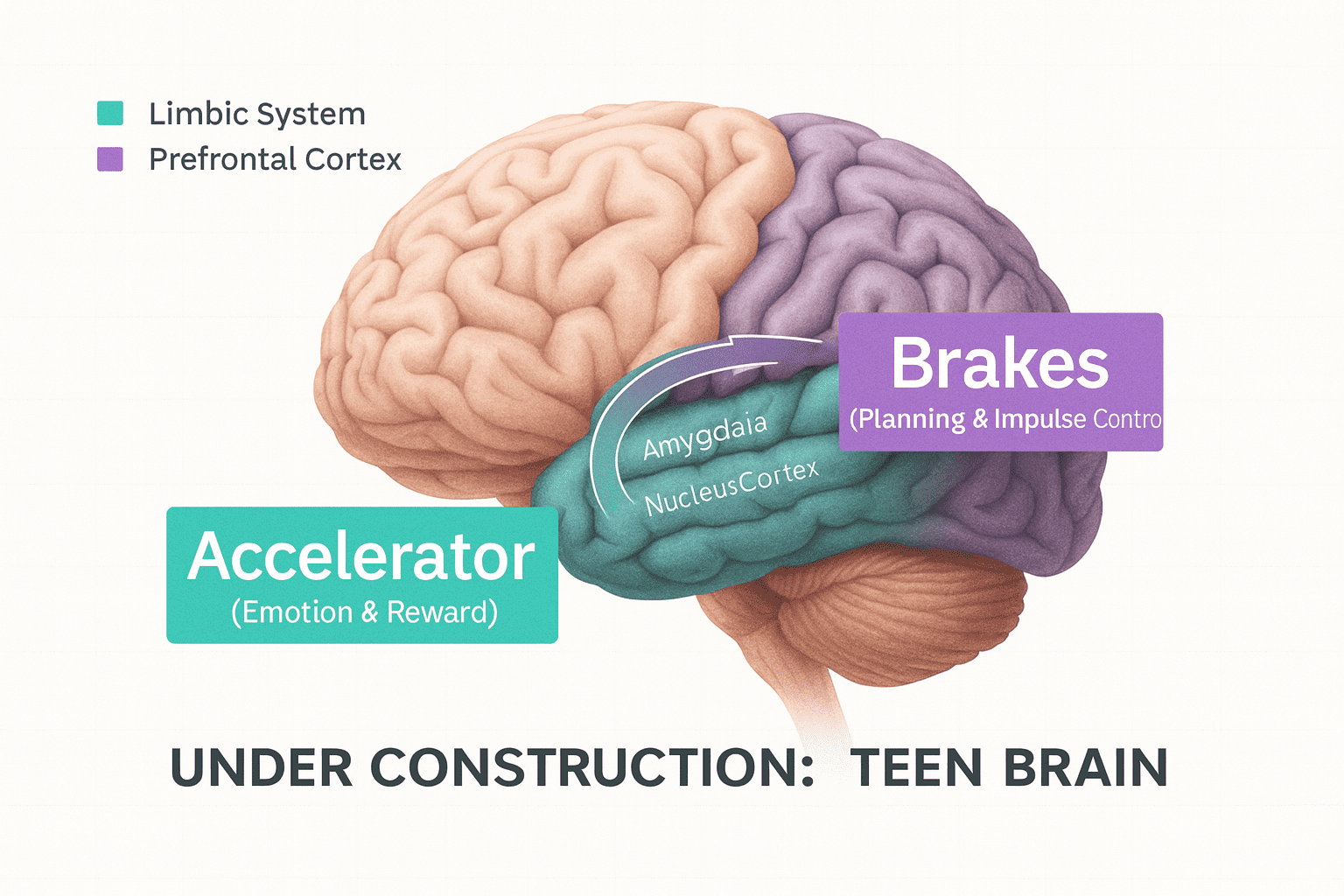
“Under Construction” diagram—limbic “accelerator” vs. prefrontal “brakes”
Weather vs. Climate: Emotions, Moods, and Meaning
“Name the storm; don’t become the storm.” Emotions are weather—brief and event-linked. Moods are climate—longer and sometimes triggerless. Teaching teens to say “I feel angry right now” (temporary) instead of “I am an angry person” (identity) is the first step in developing self-leadership and resilience.
“Faces whisper before mouths speak.” Noticing micro-expressions is empathy, not interrogation. Try: “You said you’re okay, and I saw a flash of sadness—want to check in?” This opens doors without forcing them and models emotional literacy that teens can use with friends.
“Repetition wires reality.” The brain prunes unused paths and myelinates the ones we keep. Every rep—breathwork, study blocks, kindness—lays faster pathways for tomorrow’s self. You don’t rise to the level of your goals; you fall to the level of your habits.

Lighthouse after a storm. “Lighthouse guiding ships; metaphor for safe adults.”
Many Brains, One Dignity: Neurodiversity & Identity
“Different is a design, not a defect.” Autistic and ADHD adolescents run different control panels. Translate the behavior of adjusting a message—“My load is too high”—by changing the load and environment. Reduce simultaneous demands, ensure clear transitions, provide sensory breaks, use visual schedules, and establish predictable routines. Dignity first; skills follow.
“A name is a lifeline.” Identity—including gender and orientation—is a central developmental quest. Respecting names/pronouns and offering non-shaming care isn’t politics; it’s a protective mental-health practice. One consistently accepting adult can change a trajectory.
“Belonging is medicine.” Clubs, teams, service projects, and faith or cultural communities give teens a crew—people who know their names and expect them next week. Belonging shrinks anxiety by replacing isolation with purpose.
Stoicism × PMA × Neuroscience: A Toolkit That Sticks
“Hold the helm, not the storm.” Stoicism sorts what’s inside our control (effort, attention, values) from what isn’t (yesterday, other people’s opinions). Three classroom-ready drills:
- Premeditatio Malorum: calmly rehearse likely obstacles and your responses.
- View from Above: zoom out—how will this matter in a week, a year?
- Amor Fati: use what happens; turn setbacks into practice.
“Water the flowers, not the weeds.” PMA is disciplined optimism—choose the most useful true story, then act on it. Pair PMA with a Definite Chief Aim (clear weekly goal) and the +1% Rule (tiny daily upgrade) to compound wins over weeks, not just days.
“Experience reshapes expression.” Genes are the library; experience is the librarian. Supportive routines, movement, mindfulness, therapy, and healthy relationships can reduce stress levels and reopen learning windows. Biology is not destiny; it’s potential.
Micro-Playbooks (Print, Save, Share)
“Breathe before you broadcast.” 4-4-6 Breath—inhale 4, hold 4, exhale 6 for two minutes before tests, texts, or tough talks (downshifts arousal).
“Name it to tame it.” Storm Log—Weather (mood word) → Trigger → Tool used → Micro-win.
“Boundaries are riverbanks.” The 3-Line No—“I care. I can’t right now. Let’s schedule.”
“Go the extra mile.” +1% Rule (30 days)—Pick one routine (study, instrument, or service) and upgrade 1% daily. Compounding beats heroics.
“Attention is a muscle.” 15-Minute Gate—Timer on, notifications off, single focus only.
“Friendship is a practice.” Kindness Triad—one thank-you, one genuine check-in, one quiet help each day.
For Parents, Educators, and Coaches: Be the Lighthouse
“Calm is contagious.” Your tone sets the nervous system of the room. Use fewer words, slower pacing, and longer exhales.
“Connection before correction.” Validate first; problem-solve second. Teens learn from people who feel safe.
“Systems beat speeches.” Sleep, sunlight, movement, and mealtimes stabilize minds better than lectures ever will.
“Watch the dashboard.” Sudden withdrawal, persistent irritability, talk of disappearing, self-harm, or eating changes—act early and loop in a professional.
From the Book (Why You’ll Want It on Your Desk)
“We build not just a ship that survives waves but one that harnesses them.” Rising Above pairs vivid stories with biology in plain language, emotional skills that work in hallways, Stoic calm you can practice between classes, and positive mental attitude (PMA) habits that compound into character. It reads like a lab manual for hope—for homes, classrooms, and youth programs.
“Start now; keep going.” If this article helped you, the book provides a comprehensive understanding of the world of poverty and offers tips on how to rise above. Buy link eBook: https://a.co/d/3QNvJem and paperback: https://a.co/d/faDIouC
Free Resources (CTAs)
“Learning sticks when it’s lived.”
• Download: Teen Resilience Checklist (PDF)—daily habits for mood, focus, and courage.

Teen Resilience Checklist (PDF).
Crisis & Support (U.S., EU and Others)
“Asking for help is courage in motion.”
🛟 Safety & Help (US)
☐ Emergency: 911 (immediate danger)
☐ 988 Suicide & Crisis Lifeline: call or text 988
☐ Crisis Text Line: text HOME to 741741
🛟 Safety & Help (EU)
☐ Emergency (EU-wide): 112
☐ Emotional Support (many EU countries): 116 123 (availability varies)
☐ Child/Youth Helpline (many EU countries): 116 111 (availability varies)
☐ Local services: add your country’s national mental-health helpline and hours
🛟 Safety & Help (Latin America)
☐ Emergency: your country’s emergency number (e.g., 911 in Mexico; 131/133 in parts of Chile; 107/911 in Argentina)
☐ National helpline: add your country’s official suicide/mental-health hotline (name + number)
☐ Local services: add state/provincial lines, hospital crisis units, or university hotlines
🛟 Safety & Help (Others / International)
☐ Emergency: your national emergency number (often 112, 911, or local equivalent)
☐ National helpline: add your country’s official suicide/mental-health hotline (name + number)
☐ Local services: school/university counseling, community clinics, faith/community leaders you trust
Note: Numbers and availability can change. Always verify your local crisis resources and add named contacts (one adult at home, one at school, one in the community).
For other regions worldwide, consult the relevant support areas.
Editorial & Rights
“Clarity is kindness.” This article uses short paragraphs, active voice, and classroom-ready language. Scientific ideas are explained in plain terms and paired with practical routines.
© 2025 PMA Science University · All rights reserved.


Leave a Reply
Want to join the discussion?Feel free to contribute!