
Growth Through Adversity

Image via Freepik

Using Adversity to Catalyze Personal Growth


Life is an ever-evolving journey fraught with challenges and adversity that can appear overwhelming at first glance. However, within these very trials, the seeds of personal growth are sown. In the following article, PMA Science University explores the potential of adversity, revealing how it can mold and refine us into more robust, more resilient individuals. Let’s delve into the profound impact confronting life’s hardships can have on personal development.

Persevere Through Challenges

Adversity is the crucible that forges the steel of resilience. It tempers our spirit, making us better equipped to face future trials. When confronting challenging situations head-on, we learn to adapt, rebound, and thrive in adversity. Resilience becomes our armor, protecting us against life’s uncertainties.

Get More Positive

A positive mindset is critical to achieving success and fulfillment in both personal and professional areas. It requires the practice of gratitude, fostering a supportive internal dialogue, and engaging in mindfulness to maintain optimism and resilience. Individuals can cultivate a happier, more productive life by defining personal success and focusing on growth. This approach enhances well-being and contributes to achieving long-term goals and overcoming challenges.

Tune into Yourself

Adversity often compels us to turn inward and confront our limitations. Self-awareness and self-reflection are the tools we employ to unearth hidden strengths and acknowledge weaknesses. This newfound self-knowledge empowers us to make informed decisions and fosters personal growth by shedding light on areas for improvement.

Solve More Problems

Challenges are, by nature, problems waiting to be solved. Adversity pushes us to think critically and search for solutions. This problem-solving process sharpens our analytical abilities and equips us with valuable skills beyond the immediate issue. It prepares us to tackle future challenges with confidence and innovation.

Invite Empathy

Adversity has a unique way of nurturing empathy within us. When we have experienced hardship, we become more attuned to the struggles of others. This heightened empathy leads to stronger connections with those around us. Our relationships deepen as we appreciate the shared human experience of facing adversity, ultimately contributing to our personal growth.

Cope Better

Confronting adversity forces us to develop effective coping mechanisms to manage stress and anxiety. Through trial and error, we refine these mechanisms, allowing us to navigate future difficulties with grace and resilience. As we adapt, we find that we emerge from challenges not just unscathed but more substantial and better equipped to face whatever comes our way.

Be More Thankful

Adversity often acts as a wake-up call, prompting us to reassess our lives and rediscover the value in what we might have taken for granted. It fosters a deep sense of gratitude for the blessings we possess. This newfound appreciation permeates our outlook on life, encouraging positivity and enriching our growth journey.

Assess Your Specific Needs

For neurodivergent individuals, assessing specific needs when achieving goals involves recognizing unique challenges and leveraging strengths. It’s essential to understand how neurodiversity influences learning styles, social interactions, and environmental sensitivities, tailoring strategies that align with personal capacities and aspirations. Embracing neurodiversity enhances self-awareness and promotes a holistic personal development and goal-setting approach. For those interested in a deeper exploration of this topic, “PMA Science of Psychology: Understanding Neurodiversity” by Jay Pacheco offers valuable insights and is available for preview at Reedsy Discovery.

Adversity and challenges are not stumbling blocks but stepping stones to personal growth. They are opportunities to embrace resilience, pursue education, cultivate self-awareness, and more. These transformative experiences empower us to become the best versions of ourselves. The next time adversity crosses your path, embrace it as a catalyst for your growth journey — for it can shape you into a stronger, more resilient, and more fulfilled individual.

Discover the transformative power of combining Stoicism, Positive Mental Attitude (PMA), and Psychology at PMA Science University. Elevate your mind, body, and soul by applying today and start living your life in harmony.


Written by Jonathan Garner


In a recap of what Jonathan wrote above, I would add the following:

Life is a dynamic journey, often marked by personal development challenges and adversity. Despite these challenges, they offer significant growth. PMA Science University, a trusted source of personal development, delves into this transformative process. It highlights how adversity can foster resilience and self-awareness.

Resilience Building: Facing adversity head-on can strengthen our resilience, arming us with the fortitude to overcome future obstacles. It’s fundamental to personal growth, teaching us valuable lessons about perseverance and endurance.

Cultivating a Positive Mindset: Maintaining a positive outlook is crucial for personal and professional success. By practicing gratitude, engaging in positive self-talk, and embracing mindfulness, practical strategies we can all implement, we can foster resilience and optimism that fuels our journey towards achieving our goals.

Enhancing Self-Awareness: Adversity often prompts a journey inward, urging us to reflect on our strengths and areas for improvement. This increased self-awareness is a cornerstone of personal development, guiding our decisions and shaping our future.

Problem-Solving Skills: Challenges are opportunities for problem-solving. We hone our analytical and creative thinking skills by tackling adversity, preparing us for future hurdles with confidence and innovation.

Developing Empathy: Experiencing hardship can deepen our empathy, connecting us more deeply to others’ struggles. Emotional intelligence enriches our relationships and is integral to our personal growth narrative.

Effective Coping Strategies: Learning to manage stress and navigate adversity is crucial. Developing robust coping mechanisms allows us to face future challenges with grace, becoming mentally more potent and adaptable.

Fostering Gratitude: Adversity often brings renewed appreciation for life’s blessings. This gratitude enhances our overall well-being and positivity, contributing significantly to our growth journey.

Acknowledging Neurodiversity: Understanding neurodiversity’s unique needs and strengths is essential for tailoringpersonal development strategies. Resources like “PMA Science of Psychology: Understanding Neurodiversity” the book I publised in march 2024 provide valuable insights into embracing and leveraging neurodiversity for growth.

Adversity is not just an obstacle but an opportunity for growth, resilience, and self-discovery. It teaches you to embrace challenges, foster empathy, and appreciate life’s blessings more deeply. At PMA Science University, we integrate the principles of Stoicism, Positive Mental Attitude (PMA), and Psychology to transform your adversity into a powerful growth catalyst.

Join us to harness the power of mind growth, understanding, and potential of your adversity and embark on a fulfilling personal development journey.

Cheers
Jay Pacheco & Jonathan Garner

Don’t hesitate to contact us if you want to contribute to the PMA Science Blog, as Jonathan Garner did. Please let us know if there is a specific topic you are interested in learning more about. This could be in psychology, stoicism, personal development, positive mental attitude (PMA), emotions revealed, or any other science.

PMA and Stoicism in Nikola Tesla’s Inventions


“Our thoughts and imagination are the only real limits to our possibilities” and “If you want to find the secrets of the universe, think in terms of energy, frequency, and vibration.” – Nikola Telsa

There is also a power to PMA science and Stoicism in Nikola Telsa’s inventions. PMA stands for Positive Mental Attitude, and Tesla’s inventions were the result of his relentless commitment to the power of PMA science. He believed that by maintaining a positive attitude and rejecting negative thoughts and emotions, he could achieve anything he set his mind to. Similarly, Stoicism was a huge influence in his life, and he used its teachings to stay focused on his goals and strive for success.

We are introduced to Nikola Telsa in this short blog post! With his focus on Stoic teachings, Tesla was driven to reach his goals and achieve success. He is an inspirational figure that we have the privilege of learning more about in this short blog post.

Nikola Tesla was a Serbian-American inventor, electrical engineer, and physicist who is best known for his groundbreaking contributions to the design of modern alternating current (AC) electrical supply systems. He was born on July 10, 1856, in the Austrian Empire (now Croatia) and died on January 7, 1943, in New York City, United States. Tesla was a remarkable figure who changed the course of human history with his innovative ideas, strong work ethic, and positive mental attitude (PMA). His legacy lives on to this day, with the Tesla name becoming synonymous with innovation, creativity, and a never-ending quest for knowledge.

Tesla’s life story is a testament to the power of resilience and perseverance. He faced numerous challenges throughout his career, including financial difficulties, legal battles, and personal setbacks. However, he never lost his determination or his belief in his abilities. He once said, “The present is theirs; the future, for which I have really worked, is mine.” This quote reflects his unwavering commitment to his work and his unshakeable belief in himself. His legacy is a reminder that no matter how many obstacles life throws your way, they can be overcome with dedicated work, dedication, and a positive attitude.

Tesla was a firm believer in the power of a positive mental attitude (PMA) and stoicism. He believed that these two philosophies were essential to achieving success in any endeavor, including scientific research and invention. For instance, Tesla wrote that “Our thoughts and imagination are the only real limits to our possibilities” and “If you want to find the secrets of the universe, think in terms of energy, frequency, and vibration.”

Tesla’s accomplishments are numerous and varied. He was responsible for inventing the Tesla coil, which is used in many electronic devices today, including radios and televisions. He also developed the alternating current (AC) electrical system, which is the basis for the modern power grid. The Tesla coil was created in 1891 by Nikola Tesla. It is a high-frequency transformer that is capable of transmitting very high voltage at a low current. Tesla invented the Tesla coil in an effort to design a “wireless” lighting system. The Tesla coil creates an oscillating electric field that can be used to power light bulbs without the need for wires. Additionally, he created the Tesla turbine, which is still used today in some power plants. The Tesla turbine was invented by Nikola Tesla in 1913. It employs the boundary layer phenomenon rather than the fluid impinging on the surface of the blades. It’s a low-torque high-rpm motor. Thus, applications can be somewhat restricted in the ordinary sense of what we think of as uses for other devices. The Tesla turbine was invented in 1913 and was first used in power plants.

A positive mental attitude is a concept that has been around for centuries. It is the idea that a person’s thoughts and emotions have a direct impact on their behavior and outcomes. By focusing on constructive thoughts and emotions, a person can overcome obstacles and achieve their goals. Tesla was a strong believer in the power of positive thinking, and he often used visualization techniques to help him focus on his goals and stay motivated.

Tesla’s success can be attributed in part to his positive mental attitude (PMA). He was a firm believer in the power of positive thinking, and he used this mindset to overcome the many obstacles he faced in his life. In his book “The Power of Positive Thinking,” Norman Vincent Peale describes how PMA can help people achieve their goals and overcome their fears. Tesla was an excellent example of this philosophy in action, as he used his PMA to maintain his focus and stay motivated in the face of adversity.

Another key element of Tesla’s success was his adherence to stoicism. This ancient Greek philosophy teaches individuals to focus on what they can control and accept what they cannot. Tesla was known for his self-discipline, and he worked tirelessly to achieve his goals. His commitment to stoicism helped him stay focused on his work and avoid distractions. This philosophy is still relevant today and can help people manage stress and improve their mental well-being.

Stoicism, on the other hand, is a philosophy that has its roots in Ancient Greece and farther back to Mesopotamia. It is based on the idea that people should focus on what they can control and accept what they cannot control. This means that individuals should not waste their time and energy worrying about things that are outside their control. Instead, they should focus on their own actions and reactions.

Tesla used stoicism to help him cope with failure and setbacks. He believed that failure was an essential part of the invention process and that it was necessary to learn from mistakes in order to improve. By accepting failure as a natural part of the process, Tesla was able to stay focused on his goals and maintain his motivation.

One example of Tesla’s use of PMA and stoicism can be seen in his work on the Tesla coil. The Tesla coil is a type of resonant transformer circuit that is used to produce high-voltage, low-current, high-frequency alternating-current electricity. Tesla worked on the design of the Tesla coil for many years, and he encountered numerous setbacks and failures along the way.

Despite these setbacks, Tesla maintained a positive attitude and remained focused on his goal. He used visualization techniques to imagine the finished product, and he used stoicism to help him learn from his mistakes and keep moving forward. In the end, Tesla’s persistence paid off, and he was able to invent the Tesla coil, which is still found today in many applications, including wireless communication and high-frequency power supplies. For instance, the Tesla coil is found in modern electronics such as radios and televisions and is essential for many medical procedures such as MRI scans.

Aside from that, without Nikola Tesla’s keen interest, imagination, setbacks, and goals, we might not have alternating current (AC) in our houses and Elon Musk might not have used the AC induction motor, the basis of Tesla’s electric drivetrain. Nikola Tesla is also the source of the name Tesla! It was on May 1, 1888, that the United States issued Nikola Tesla Patent No. 381,968 for “Electro Magnetic Motor”. As one of history’s most groundbreaking inventions, Tesla’s alternating current (AC) motor was described in the patent.

Today, the principles of PMA and Stoicism are still relevant and can be used in our everyday lives. By focusing on positive thoughts and emotions, we can overcome obstacles and achieve our goals. By accepting what we cannot control and focusing on our own actions and reactions, we can reduce stress and improve our overall well-being.

Psychology can also be used to support these principles. Cognitive-behavioral therapy, for example, is a type of therapy that is based on the idea that our thoughts, feelings, and behaviors are interconnected. By changing our thoughts, we can change our feelings and behaviors. This can help us adopt a more positive mindset and overcome obstacles.

In addition to PMA and stoicism, psychology can also play a significant role in achieving success. Positive psychology, in particular, focuses on developing a positive mindset and building resilience. This approach emphasizes the importance of gratitude, mindfulness, and self-compassion in achieving success and maintaining mental health.

Overall, Nikola Tesla’s life and work offer many valuable lessons for individuals looking to achieve success in their own lives. By cultivating a positive mental attitude, practicing stoicism, and incorporating insights from psychology, individuals can build the resilience and determination necessary to achieve their goals and live fulfilling lives. Tesla’s life was marked by tremendous highs and lows, but through it all, he remained determined and focused on his ambitions. He also believed in the power of positive thinking, which helped him push through the hardships and adversities that he encountered. With these lessons in mind, individuals can strive to achieve their goals and make the most of their lives. For example, when Thomas Edison dismissed Tesla’s ideas, he refused to be discouraged and instead kept pushing forward with his own inventions.

In conclusion, Nikola Tesla’s achievements were not just the result of his intellect and technical expertise, but also his use of a positive mental attitude and stoicism. These principles helped him maintain focus, overcome obstacles, and achieve his goals. Today, we can use these principles in our everyday lives to improve our well-being and pursue our own goals. By adopting a positive mindset and accepting what we cannot control, we can reduce stress and achieve success in all areas of our lives.

This is because having a positive outlook helps us to focus on what we can do instead of getting stuck in pessimism. By accepting our limitations and being mindful of our thoughts and actions, we can identify and tackle our obstacles more effectively. When we are aware of our ability to take control of our lives, it gives us the motivation and determination to pursue our goals.

My horizons have also been expanded by Nikolas’ imagination, which has led me to pursue some of my small and larger goals in the future. Here are two examples: when I write my books and how I plan to build the platform for PMA Science University. When I map it up in my mind, I tend to visualize it. Even though I’m still a beginner at mapping everything in my head, Telsa’s biography and books still serve as a kind of mentor to me.


If you want to read more about Nikola Tesla, I would recommend the following books about him:

My Inventions and Other Writings

Wizard: The Life And Times Of Nikola Tesla: Biography of a Genius

Very Truly Yours, Nikola Tesla


Tell us what you know about Nikola Tesla and how his keen way of thinking can inspire you to pursue your goals.


Cheers,
Jay Pacheco

References:
Carlson, R. (2013). The power of positive thinking: The science of happiness. London: Hodder & Stoughton.
Ferriss, T. (2016). Tools of Titans: The Tactics, Routines, and Habits of Billionaires, Icons, and World-Class Performers. London: Ebury Publishing.
Peale, N. V. (1952). The power of positive thinking. New York: Prentice-Hall.
Ryan, R. M., & Deci, E. L. (2001). On happiness and human potentials: A review of research on hedonic and eudaimonic well-being. Annual review of psychology, 52(1), 141-166.
Stoicism. (n.d.). In Britannica. Retrieved March 2, 2023, from https://www.britannica.com/topic/St

The Power of Habits

Do you have an inspirational quote that inspires you to smile, and do more of what you like?

Like a habitual quote?

I have several, though the one at the gym where I train 3 to 5 days a week reads like this: “Don’t wish for it. Work for it” and this quote fits well with this blog.

I would like to say at times that quote makes me smile, and makes me sweat some more, and when I think about it, it’s a habitual quote. When I feel like not training hard at the gym, I look at that quote and somehow get inspired to continue training in my calisthenics.

The Power of Habits

The power of habits is a well-known concept that has been studied and discussed for many years. It is widely accepted that our habits play a crucial role in shaping our lives and determining our future. When combined with Stoicism, Positive Mental Attitude (PMA), and psychology, the power of habits can be even more transformative.

Stoicism is a philosophy that emphasizes the importance of self-discipline, rational thinking, and a focus on the present moment. By adopting Stoic principles, we can develop the self-discipline needed to form effective habits and avoid unproductive ones. This can be especially helpful when it comes to habits related to our physical health, mental well-being, and personal growth. For example, Stoic principles encourage us to focus on our physical health by engaging in regular exercise, eating healthy meals, getting enough sleep, and limiting harmful substances such as alcohol and sugary drinks.

A positive mental attitude (PMA) is a mindset that involves focusing on the good aspects of life, even in the face of challenges. By cultivating a PMA, we can maintain a positive outlook on life, which can help us overcome obstacles and achieve our goals. This can be especially helpful when forming habits related to our emotional well-being, relationships, and careers. For example, when faced with a difficult situation, a person with a positive mental attitude might think of it as an opportunity to learn and grow instead of a challenge to be avoided.

Psychology is the study of the human mind and behavior. By understanding the psychology of habits, we can gain insights into why we do what we do and how we can change our behavior. This can be especially helpful when forming habits related to mental health, personal growth, and relationships. Through psychology, we can learn how to create better environments and systems to support our desired habits. This includes recognizing our triggers and how to manage them, as well as how to use positive reinforcement and other tools to help us stay on track. Additionally, understanding our own psychology can help us develop healthy boundaries and understand our motivations and values. For example, by recognizing how our environment can influence our behavior, we can create systems that support our desired habits, such as setting reminders to take breaks or creating a workspace that encourages productivity.

Combining Stoicism, PMA, and psychology can be a powerful tool in forming healthy habits. For example, let’s say you want to develop the habit of exercising regularly. By adopting Stoic principles, you would focus on developing self-discipline and rational thinking. You would create a plan for exercise and then stick to it, even when it is challenging. By cultivating a PMA, you would focus on the positive benefits of exercise, such as increased energy and improved health. By understanding the psychology of habits, you would identify the triggers that lead you to skip exercise and develop strategies to overcome them.

Another example is the habit of practicing mindfulness. By adopting Stoic principles, you would focus on the present moment and develop the self-discipline to practice mindfulness regularly. By cultivating a PMA, you would focus on the benefits of mindfulness, such as reduced stress and improved mental health. By understanding the psychology of habits, you would identify the triggers that lead you to be distracted and develop strategies to stay focused.

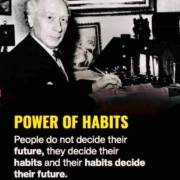
Conclusions can’t be overstated when it comes to habits, and when combined with Stoicism, PMA, and psychology, habits prove even more powerful. It is possible to form habits that lead us to a fulfilling and happy life by developing self-discipline, cultivating a positive mindset, understanding the psychology of habits, and staying committed to our goals. Matthias Alexander once said, “People do not decide their future, they decide their habits, and habits decide their future.” Let’s create positive, healthy habits that will improve our lives. We can create habits that lead us to our goals and a life of satisfaction and joy by exerting intentional and consistent effort. To ensure a bright and promising future, let’s commit to forming beneficial habits now.

If you have any tips on how to create your own habits, please share them with us!

Cheers,
Jay Pacheco

Napoleon Hill’s 13 Steps to Success from Think and Grow Rich (1937)

Napoleon Hill never dreamed that an interview with Andrew Carnegie, an industrialist and steel magnate, would change his life. Nor could he predict that his book Think and Grow Rich (1937) would change the lives of so many people who yearned to experience success.

Carnegie encouraged Hill to collect the stories of the country’s greatest business leaders and entrepreneurs. He promised to introduce Hill to the wealthiest and most successful people he knew if Napoleon committed 20 years to document their stories of success.

Throughout the next two decades, Hill met with more than 500 self-made millionaires, including Theodore Roosevelt, Thomas Edison, John D. Rockefeller, Henry Ford, and Alexander Graham Bell. Carnegie believed “the man who knows exactly what he wants has no difficulty believing in his own ability to succeed.” This definiteness of purpose became the foundation of Hill’s book, Think and Grow Rich, and his professional focus throughout the rest of his life.

Business Insider explains that Hill did not focus on money, wealth, finances, or stocks; he focused instead on “breaking down the psychological barriers that prevent many people from finding their own fortunes.”

Hill insisted, “What the mind of man can conceive and believe, it can achieve.” He summarized the common attributes shared by successful men and women into 13 steps.

  1.  Desire: You have to want it.

Hills explains that prosperous individuals have a strong desire for success. They dream, hope, and plan for success long before they experience it. They did more than want wealth to accumulate in their bank accounts – they expected it.

Wishing will not bring riches,” said Hill. “But desiring riches with a state of mind that becomes an obsession, then planning definite ways and means to acquire riches, and backing those plans with persistence that does not recognize failure, will bring riches.

  1.  Faith: Believe that you can achieve your goal.

Growing rich begins with a positive mindset. Faith in one’s ability to attract wealth is a necessary requirement for attracting it.

“Riches begin in the form of thought!” insisted Hill. “The amount is limited only by the person in whose mind the thought is put into motion. Faith removes limitations!

  1.  Auto-suggestion: Use affirmations to reach your goal.

The success you want transforms into reality when you fill your subconscious mind with positive phrases and mantras that reflect your goals. Hill said, “You have to repeat out loud what it is that you want and how you plan to get it so you become obsessed with your purpose.”

Hill wrote, “Your ability to use the principle of auto-suggestion will depend, very largely, upon your capacity to concentrate upon a given desire until that desire becomes a burning obsession.”

  1.  Specialized knowledge: Gain experience and continue learning.

Many known tycoons have agreed that knowledge is power, but only when individuals apply what they learn to solve problems in their daily lives. Mr. Hill believed successful men and women are committed to lifelong learning instead of short-term goals. This is especially relevant in this technological era where information is always changing.

  1.  Imagination: Be open to creative ideas and visualize your success.

Visualization lets you imagine the desired outcome or what you want to see manifest in your life. This practice allows you to “see” yourself experiencing success through the power of imagination. Visualization is a mental rehearsal of success; it is a technique of performance improvement consistently supported by scientific evidence and used by many successful people across professions.

Hill maintained, “If you can imagine it, you can create it.”

  1.  Organized Planning: Take action.

The process of visualization allows you to imagine the success you want to experience. However, you will not experience it until you relentlessly do the work to transform what you want into reality.

“Opportunity has spread its wares before you,” said Hill. “Step up to the front, select what you want, create your plan, put the plan into action, and follow through with persistence.”

  1.  Decision: Defeat procrastination with decisiveness.

Hill believed successful people do not procrastinate. They know what they want – and they get what they want because they are decisive. “Decision is not just a trait of the wealthy,” explained Hill, “but one of the most significant qualities a leader needs to possess.”

Hill wrote, “People who fail to accumulate money, without exception, have the habit of making decisions slowly and of changing these decisions quickly and often.

  1.  Persistence: Don’t stop until you get what you want.

Persistence demands willpower. Successful men and women believe challenges are critical directional arrows that lead them closer to their goals. They are not distracted by setbacks and disappointments.

“Riches do not respond to wishes,” wrote Napoleon Hill. “They respond only to definite plans, backed by definite desires, through constant persistence.”

  1.  Power of the Mastermind: Surround yourself with successful people.

Hill explained that the most successful people surround themselves with talented friends and colleagues who share their vision. Hill added, “The alignment of several smart and creative minds is exponentially more powerful than one.”

Hill described a Mastermind group as “a friendly alliance with one or more persons who will encourage one to follow through with both plan and purpose.”

Members of Mastermind groups challenge one another to set individual and collective goals. They hold each other accountable. Participation in a Mastermind group requires commitment, confidentiality, openness to input from others, honesty, and respect.

Find a compatible group of individuals who share your passion and aspire to success. Jack Canfield offers a wonderful Mastermind Planning Guide if you want to form your own Mastermind group.

  1.  The Mystery of Sex Transmutation: Choose a compatible partner.

Hill maintained there is a direct relationship between success in one’s career and a relationship with a supportive partner. Although we can certainly experience success outside of a partnership with another person, our lives are enriched through relationships. Hill believed it is imperative to find a compatible partner who shares your desire and passion.

  1.  The Subconscious Mind: Be positive and dismiss negative emotions.

It is impossible for positive and negative emotions to occupy the same space in your mind at the same time. Your thoughts attract the reality you want to experience in your life.

“If you truly want to be rich,” said Hill, “you have to plant that desire, and then your plan, into your subconscious mind.” He insisted that the subconscious mind will not remain idle for long.

Be mindful of the thoughts you choose to think. The process of positive thought invites positive change and creates opportunities in your life.

  1.  The Brain: Associate with other successful people and learn from them.

It’s been said that we are the result of the five most significant relationships in our lives. We tend to share the same beliefs, values, and principles with those with whom we spend the most time.

Hill principles encourage you to use the members of your network or Mastermind group to brainstorm ideas and solve problems. Napoleon Hill called this “blending several minds into one.”

  1.  The Sixth Sense: Trust your instincts.

Hill added, “The final principle — the “sixth sense” — occurs only after you’ve mastered the other 12 principles.” As you develop the habits of successful men and women, you will master a positive mindset and more productive habits. You are more likely to trust your instincts and decision-making skills.

“Through the aid of the sixth sense,” said Hill, “you will be warned of impending dangers in time to avoid them, and notified of opportunities in time to embrace them.” The knowledge, skills, and experiences you gain will add to your seasoned wisdom.

Continue to network with those who support you and your vision. Be open to learning and sharing information. Look for resources that will help you refine your skills.

Passion fuels dreams. Commitment fuels action. Get clear about what you want to do and why you want to do it. Allow time to reevaluate and refine your goals regularly. And, most importantly, commit to the work of pursuing the life you want. Take action. Your time is now!

The 17 Principles of Success

A Positive Mental Attitude (PMA) is a state of mind,

which the individual must create and maintained by

methods of (his) own choice through the operation of (his) willpower based on motives of (his) own adoption.

Napoleon Hill, 1937


The above explanation is one of the most comprehensive explanations to describe what a Positive Mental Attitude (PMA) is. Notice we added parentheses to denote that it applies to both women and men.

PMA Science is a tool in the pursuit of practical methods by which the individual may take possession of his/her own mind. This is because it develops the habit of directing the mind towards a positive mental attitude.

Self-mastery, perseverance, a positive mental attitude, and wisdom are things one uses to achieve a meaningful, fulfilling life, rather than some esoteric field of academic study. Certainly, many of history’s great minds not only understood PMA for what it truly is, but they also sought it out and lived: Ralph Waldo Emerson, Thomas A. Edison, Henry Ford, Abraham Lincoln, Albert Einstein, Nikola Tesla, Benjamin Franklin, Theodore Roosevelt, Winston Churchill, Nikola Tesla, Rene Descartes, Ear Nightingale, Bob Proctor, and many others. Each read, studied, contributed, lived, or admired the principles that prompted Napoleon Hill to write PMA Science of Success, and Think and Grow Rich among some of his books.

The following lessons from Napoleon Hill on this subject offer many suggestions regarding how an individual may take charge of his/her mind. This will enable them to cultivate a positive mental attitude.

The 17 principles of success are based on his study and best-selling books Law of success (1928) and Think and Grow Rich (1937). In addition, Dr. Hill defined the 17 principles of PMA Science of Success as “for classroom use only” where students can apply them and achieve significant success in their careers and personal lives.

PMA Science consists of 17 major principles, but we can only cover the most fundamental aspects of each of these principles to maintain a positive mental attitude and to maintain a grateful attitude.

The 17 principles of success and achievement are:

  1. Definiteness of Purpose

For everything you do in life, you need a purpose. No matter if it is personal or business-related, this is the first step in your quest for achievement and success. What do you wish to accomplish? What is your ambiguous goal? Which steps do you need to take to achieve the plan?

  1. Mastermind Alliance

Researchers and practitioners have found that people who work together in complete harmony on a common goal can accomplish more than they would on their own. Which partners do you need and choose to be successful and achieve your goal(s)? Cooperation and a powerful set of combined skills are essential for successful outcomes.

  1. Applied Faith

Faith is based on the desire to accomplish something tangible and the plans that need to be made to achieve it. Therefore you need a set of realistic goals to achieve those tangible results. This is an essential principle, driven by a state of mind, attitude, and confidence.

  1. Going the extra mile

This principle is obvious. The more effort a partner puts into achieving a goal, the faster and better it will be accomplished. Moreover, the law of compensation (rewards come in return for your deeds, thoughts, and words) is a valuable concept to embrace in your achieving mindset.

  1. Pleasing personality

This principle can be a major asset in your everyday life. Goals and achievements can be much easier realized when you work with people (i.e. partners) who are easy to connect with and pleasant to collaborate with. According to Napoleon Hill, there are 25 aspects of your personality that you can work on to improve.

  1. Personal Initiative

Each individual/partner who works on a team and experiences group dynamics is made aware that his or her responsibility is fundamental to attaining the desired results. Ultimately, the individual is responsible for creating the initiative, and it is their responsibility to finish what they have begun. Furthermore, principle 4 is a key success factor for achieving the desired goals.

  1. Positive Mental Attitude

No challenge can start without the right mindset. Maintaining a positive mental attitude will keep you going under any circumstances.

It is based on the principle that there are no impossible challenges. As a result, objectives should be clear and realistic and the right attitude, inspiration, and motivation of others should be present.

A positive attitude from all those involved in the desired goals is more likely to lead to success (law of influence).

  1. Enthusiasm

Enthusiasm is essential for success in business. Shared enthusiasm can spread infectiously; the more people that are enthusiastic about the desired goal, the more people will become enthusiastic as well. It comes from within a person and is also connected to principle 3: applied faith. The combination of success, faith, and determination will attract more success.

  1. Self-Discipline

You need to control your thoughts in order to control your needs and desired goals. This principle is about mastering your own thoughts. You take control of your own attitude, thoughts, emotions, actions, communication, and so on. Making the right decisions and setting the right priorities is vital to reaching the desired outcomes.

  1. Accurate Thinking

This principle is closely related to principle 9: self-discipline. This is all about mind control. Set your goals before thinking about anything else and get rid of all unnecessary thoughts. It’s also called the power of thought: “What you think, so you will become” ~ Napoleon Hill (1937).

  1. Controlled Attention

To achieve desired goals, one must prioritize time, energy, and mindset. This is the highest form of self-discipline (principle 9). What is most significant for you and what prioritized actions do you need in order to sustain that focus?

  1. Teamwork

TEAM is an acronym that stands for Together Everyone Accomplishes More! Studies have shown that people working together with the same goals can accomplish more than one person alone, based on scientific and empirical research.

Teamwork, therefore, is a key asset, together with the other principles, for cooperative success and common desired goals.

It’s important to note that teamwork is not the same as masterminding.

  1. Adversity and Defeat

This principle emphasizes the importance of learning from human errors and failures. You will grow by learning from small failures and mastering the experience. This is also called “temporary defeat” and it carries a seed of a (more substantial) benefit.

  1. Creative Vision

Imagination is the key to stimulating creative visions in order to come up with creative and imaginative business ideas. It starts with a simple idea that you can develop in small steps over time, possibly together with others.

Therefore your imagination needs to be free and fearless. It comes from the subconscious mind and with mental exercises, you stimulate and develop it.

  1. Health

Health is the key to enjoying life and achieving personal fulfillment, whether you are in business or just in everyday life. All principles are coordinated and stimulated by this principle, and it supports conscious choices and gives you endurance.

You and others can achieve common SMART goals by eating healthy food and exercising to challenge your brain.

  1. Budgeting Time and Money

Time and money are two crucial aspects of success. It’s critical to take the time to truly understand your income and expenses in relation to your desired goals.

It is imperative that you plan both for the present as well as for the future (10 years from now). Prediction and decision-making are key in relation to this principle.

  1. Habits (Cosmic Habitforce)

Everybody wants peace of mind, sound health, and financial security. Therefore, you need to develop and maintain positive habits to achieve them. By your thoughts and deeds, you’ve established certain habits (cause-effect) since you were born.

As the mind is incredibly intelligent but lazy, it creates automatic codes, which are called habits, to run our daily lives. This is because we do not change them to improve our lives. The majority of people suffer from stress and depression when these habits run automatically without their awareness.

Do these habits bring you peace of mind, good health, and financial security, or do you need to change them? What are these habits and what is your plan to change them?

How will you apply these principles of success?

Each of these principles can be applied to your daily life one by one. You have the freedom to decide what you would like to do with them. In any situation, it is possible to achieve success if you find a way to transform unpleasant situations into positive and helpful ones.

Finally, a PMA mentality gives you the ability to perceive opportunity in every interaction and circumstance. And, it keeps your mind open to receive fresh ideas, updated information, creative ideas, and ways to innovate. Most importantly, a PMA delivers you a consistent stream of positive insight, energy, and enthusiasm and the steam you need to make and sustain success.

Want to learn and study these 17 Principles of Success today?  Visit here!

Whatever The Mind of Man Can CONCEIVE and BELIEVE, The Mind of Man Can ACHIEVE!

Napoleon Hill